September 2026 Working Holiday Visa update: 417 & 462 processing delays, country cap pauses, age limit changes, and ballot systems explained

 about 4 hours ago
| Extension | Previous places | Updated places |
| 2nd Year | 57,000 | 45,000 |
| 3rd Year | 31,000 | 5,000 |
A Working Holiday visa lets young adults holiday in Australia and work to pay for their trip. Second- and third-year extended working holiday visas will now be allocated through a ballot system. The changes are part of a broader effort to reduce net overseas migration from 292,100 to 225,000 by 2028. Here’s everything you need to know about the working holiday visa and the latest changes to it:
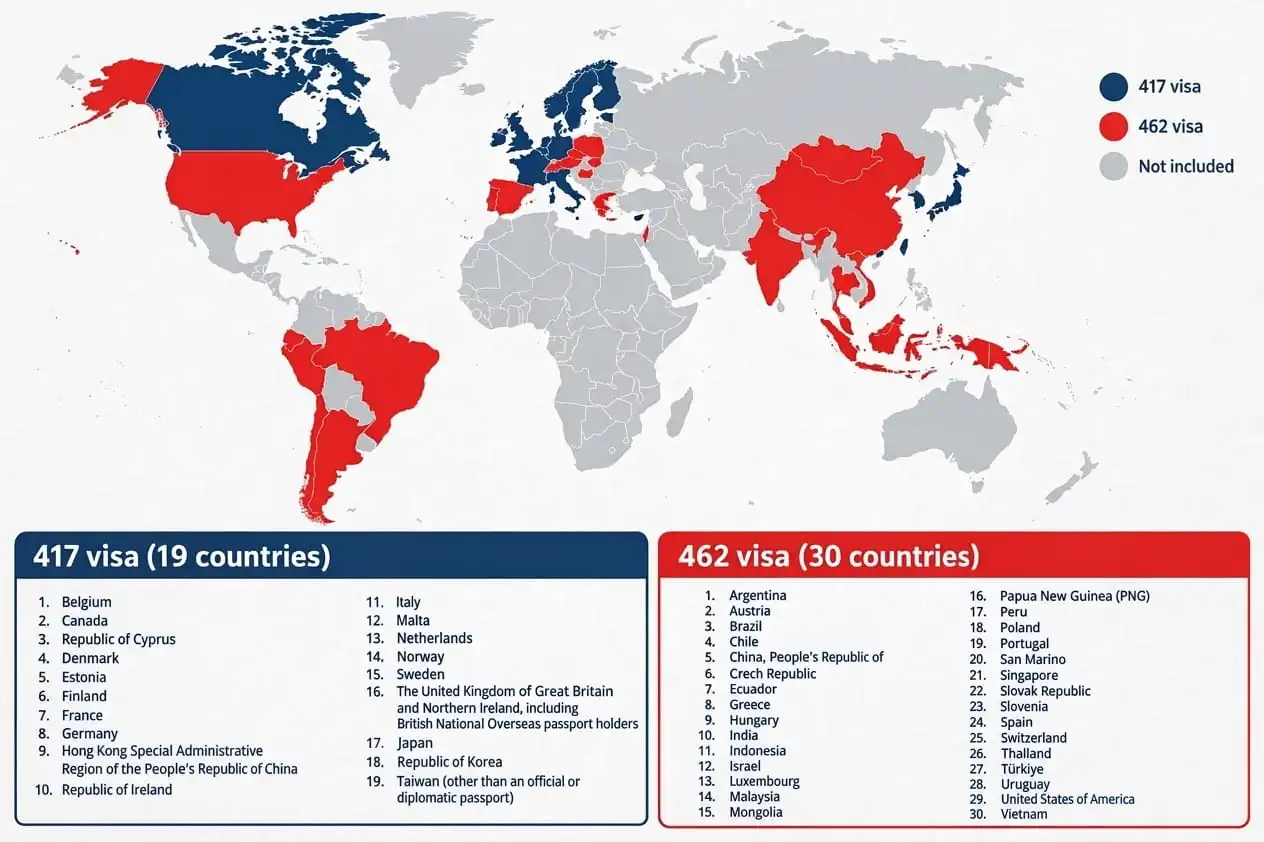
The working holiday visa is a temporary permit that lets young adults live and work in Australia for up to 12 months. Depending on the passport, it is categorised into two different subclasses:
i) Subclass 417 (working holiday)
ii) Subclass 462 (work and holiday)
Working Holiday visa subclass 417 is for passport holders of partner countries with an uncapped limit, meaning any number of people can be granted this visa, and there is no such maximum number of visa grants per year for citizens of partner countries for the first year.
Work and Holiday visa subclass 462 is available to citizens of a list of countries with a cap limit, meaning only a certain number of people are granted a subclass 462 visa. Example: only 500 people from Austria are granted a subclass 462 visa per year.
| Requirement | WHV subclass 417 | WHV subclass 462 |
| Age | 18–30 or 18–35 (depending on passport) | 18–30 for all eligible countries |
| Education | No formal education requirement | Tertiary qualification or 2 years of undergraduate study required |
| Letter of support | Not required | Required for some countries. |
| Ballot | Not applicable for a first working holiday visa, and an exemption applies to UK passport holders | Required for China, India, Vietnam currently and Indonesia from late 2026 |
| Funds | AUD $5,000 + return ticket | AUD $5,000 + return ticket |
| Dependent children | Cannot be accompanied | Cannot be accompanied |
| Previous visa | Must not have previously entered on a 417 or 462 | Must not have previously entered on a 417 or 462 |
| Activity | Subclass 417 (working holiday) | Subclass 462 (work and holiday) |
| Work | Any kind of work to fund your holiday. Limit of 6 months per employer | Any kind of work to fund your holiday. Limit of 6 months per employer |
| Study | Up to 4 months | Up to 4 months |
| Travel | Travel to and from Australia as many times as you want while the visa is valid | Travel to and from Australia as many times as you want while the visa is valid |
| Stay duration | 12 months from the date you enter Australia | 12 months from the date you enter Australia |
| Extend (2nd year) | Do 3 months of specified work to become eligible | Do 3 months of specified work to become eligible |
| Extend (3rd year) | Do 6 months of specified work during your second year | Do 6 months of specified work during your second year |
The Australian government has announced significant changes to the working holiday visa as part of its migration reforms. Here’s what has changed:
•Ballot system for second and third-year visas
Second and third-year working holiday visas will now be allocated through a ballot system. (An exemption applies to UK passport holders) Under the previous rules, visa holders who completed specified work were automatically eligible for an extension. Under the new rules, completing the work makes you eligible to enter a ballot, but does not guarantee an extension.
•Caps on extension places
The number of available extension places has been reduced
| Extension | Previous places | Updated places |
| 2nd Year | 57,000 | 45,000 |
| 3rd Year | 31,000 | 5,000 |
•Processing delays and current status
As of now, processing for a large number of offshore applications is facing major delays. According to the Department of Home Affairs website in August 2026, offshore applications may take several months due to high volumes. San Marino and Türkiye are the only countries currently open, each with an annual cap of 100 places.
•UK applicants
The number of UK Working Holiday visa applications has increased from around 17,000 to nearly 80,000. The government said it is processing UK applications more slowly while discussing the visa situation with the UK government regarding the current visa situation.
•Migration targets
The changes are part of a broader effort to reduce net overseas migration from currently 292,100 to 225,000 by 2028. Working holiday makers are a key component of temporary migration.
If your working holiday visa is expiring soon, your options don't disappear overnight, but they do become significantly more limited the longer you wait.
It cannot be extended beyond its 12-month duration. However, you may be eligible to apply for a second and then a third extension, each granting an additional 12 months, if you meet the requirements. Once your WHV expires, you must either:
If you want to continue your life in Australia, a student visa may allow you to study and remain in Australia legally, if you meet the relevant visa requirements.
Options to explore include:
These changes are significant, and understanding how they apply to your specific situation can be complex. Whether you're planning your first Working Holiday visa, hoping to extend your stay, or exploring other visa pathways, Search Education is here to help.
Why us though?
Book a Free Consultation with our expert counselors

© 2026 SearchEducation | All Rights Reserved.